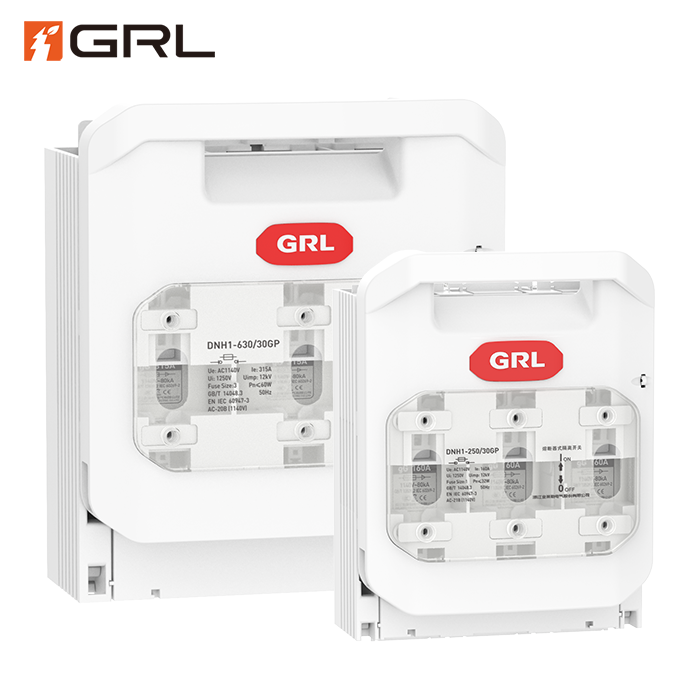
| Product model | DNH1-250/30GP | DNH1-630/30GP |
| Rated operating voltage Ue | AC 1140V | AC1140V |
| Fuse size | 1 | 3 |
| Frame-rated Operational Current le | 160A | 315A |
| Frame-size Conventional Thermal Current Ith | 160A | 315A |
| Fuse rated operating current le | 6A~160A | 200A~315A |
| Usage category(with fuse) | AC-20B | |
| Rated short-circuit current lq(with fuse) | 80kA | |
| Rated insulation voltage Ui | 1250V | |
| Rated impulse withstand voltage Uimp | 12kV | |
| Rated frequency | 50/60Hz | |
| Maximum tightening torque | ≤20N.m | ≤28N.m |
| Level of protection | On:IP20/Off:IP30 | |
| Way to install | Vertical installation | |
| Mounting type | Fixed installation | |
| Ordered separately | Protective cover,auxiliary switch,mechanical fuse monitoring | |
In the evolving landscape of heavy industry, mining operations, and large-scale power distribution, the shift towards higher operating voltages is a definitive trend. Moving from standard 400V or 690V systems to 1140V AC allows engineers to transmit power over longer distances with reduced voltage drop and lower cable costs. However, this increase in voltage places immense stress on electrical components, demanding a new tier of protection devices capable of handling these rigorous conditions without failure.
The GRL DNH1GP Series Fuse Switch Disconnector has been engineered specifically to answer this challenge. Designed with a rated working voltage of AC 1140V, this series serves as a critical guardian in power distribution circuits and high-load motor circuits. It is not merely a switch; it is a robust integration of isolation and protection, tailored for environments characterized by high short-circuit currents and severe operational demands.
The foundation of the DNH1GP Series lies in its superior insulation architecture. When dealing with voltages exceeding 1000V, the risk of dielectric breakdown and arcing increases significantly. To mitigate this, the GRL DNH1GP series is constructed with a Rated insulation voltage (Ui) of AC 1250V. This specification provides a crucial safety margin of 110V above the rated operating voltage, ensuring that the device remains electrically stable even during minor system fluctuations.
Furthermore, industrial environments are prone to transient overvoltages—sudden spikes in energy caused by lightning strikes, grid switching, or large inductive load dumps. The DNH1GP Series boasts a Rated impulse withstand voltage (Uimp) of 12kV. This impressive rating indicates that the switch can safely withstand high-energy transients up to 12,000 volts without experiencing flashover or insulation failure. This level of robustness is essential for maintaining continuity of service and protecting personnel in harsh operating environments such as underground mines or heavy manufacturing plants.
Get Quote

A defining feature of the DNH1GP Series is its operational versatility, allowing it to function in two distinct modes based on the internal component installed. This flexibility allows facility managers to standardize on a single switch housing while adapting the function to specific circuit requirements.
In its primary configuration, the device functions as a fuse-type isolator. It is compatible with NH-P fuse links, specifically designed for the NH size 1 and NH size 3 form factors depending on the model. In this mode, the device provides comprehensive protection against two of the most destructive electrical faults:
Overload Protection: Preventing damage from sustained excessive currents that cause overheating.
Short-Circuit Protection: Rapidly interrupting massive fault currents to prevent catastrophic equipment failure or fire.
The user prompt highlights a critical adaptability feature: the ability to replace the fuse with an isolation knife. When configured with an isolation knife, the nature of the device changes. It ceases to offer circuit overload or short-circuit protection. Instead, it transforms into a dedicated disconnector, solely meeting the line isolation requirements specified for the switch. This mode is particularly useful for establishing a visible, physical break in the circuit to ensure the safety of maintenance personnel working downstream, provided that upstream protection is handled by a different device.
The series is divided into two primary models, catering to different current requirements within the 1140V ecosystem.
This model is the compact powerhouse of the series. Despite its specific model number suggesting a larger frame, the technical data clarifies its precise operational limits to ensure safety at high voltages.
Current Rating: It features a Frame-rated Operational Current (Ie) of 160A and a matching Frame-size Conventional Thermal Current (Ith) of 160A.
Fuse Compatibility: Designed for Fuse size 1, it supports a fuse rated operating current range from 6A to 160A. This wide range allows for precise matching to the specific load, whether it is a small control circuit or a mid-sized motor.
Mechanical Torque: To ensure a low-resistance connection essential for heat management, the maximum tightening torque for this model is specified at less than or equal to 20 Newton-meters.
For higher power applications, the 630/30GP model provides increased capacity.
Current Rating: This unit offers a Frame-rated Operational Current (Ie) of 315A, with a corresponding Thermal Current (Ith) of 315A.
Fuse Compatibility: It utilizes the larger Fuse size 3, accommodating fuse links rated from 200A up to 315A.
Mechanical Torque: Given the larger conductors required for 315A, the terminals are designed to withstand higher clamping forces, with a maximum tightening torque of less than or equal to 28 Newton-meters.
One of the most critical specifications for any protection device is its breaking capacity—the maximum current it can safely interrupt without exploding or destroying itself. The DNH1GP Series excels in this regard.
Both models in the series feature a Rated short-circuit current (Iq) of 80kA (when equipped with the appropriate fuse). An 80,000 Ampere fault is a massive release of energy that can vaporize standard conductors in milliseconds. The ability of the DNH1GP to withstand and facilitate the interruption of such currents speaks to the robust mechanical design of its contact system and arc suppression capabilities. This high short-circuit rating makes it suitable for installation in main distribution boards where the prospective fault current is naturally highest.
The technical data classifies the DNH1GP series under the usage category AC-20B. Understanding this category is vital for safe operation.
AC-20: This category typically denotes connecting and disconnecting under no-load or negligible load conditions.
B: The suffix ‘B’ generally indicates infrequent operation.
This classification suggests that while the fuses provide automatic protection under load (breaking faults), the manual switching operation itself is primarily intended for isolation purposes when the load has effectively been disconnected or is negligible. This aligns with its description as a “fuse-type isolator,” emphasizing its role in safety isolation and circuit segmentation rather than frequent functional switching of active motors.
The physical installation and safety features of the DNH1GP are designed with the installer and operator in mind.
The device is engineered for Fixed installation and must be mounted in a Vertical installation orientation. Vertical mounting is critical in switchgear design as it aids in natural convection cooling (heat rises away from the contacts) and assists in the optimal performance of the arc extinguishing mechanisms during a fault.
Safety against accidental contact is non-negotiable in 1140V systems. The DNH1GP series offers variable protection levels based on its state:
ON Position (IP20): When the switch is closed and conducting power, it provides IP20 protection. This means it is touch-proof against objects larger than 12mm (like fingers), protecting operators from accidental contact with live parts during routine inspection.
OFF Position (IP30): When switched off, the protection level increases to IP30. This offers protection against solid objects larger than 2.5mm, providing enhanced safety during maintenance or lockout/tagout procedures involving the face of the switch.
To meet complex system monitoring requirements, the DNH1GP series supports a suite of accessories that can be ordered separately. These additions transform the standalone switch into a smart, integrated component of a larger automation system.
Auxiliary Switch: This allows the physical position of the main contacts (Open or Closed) to be signaled remotely to a PLC or control room.
Mechanical Fuse Monitoring: In critical processes, downtime must be minimized. The mechanical fuse monitoring accessory provides immediate feedback if a fuse blows, allowing maintenance teams to pinpoint the fault location instantly without manual testing.
Protective Cover: Additional covers can be fitted to further enhance safety and prevent dust ingress or accidental tampering.
The GRL DNH1GP Series Fuse Switch Disconnector represents a specialized engineering achievement tailored for the niche but vital 1140V AC sector. By combining a high rated insulation voltage of 1250V, a substantial impulse withstand capability of 12kV, and a massive short-circuit breaking capacity of 80kA, it offers a fortress of protection for industrial electrical assets.
Whether configured with NH-P fuse links for active fault protection or with isolation knives for safe maintenance segmentation, the DNH1GP series delivers reliability and flexibility. Its rigorous specifications—ranging from the 160A and 315A frame options to the strict torque and mounting requirements—demonstrate GRL’s commitment to safety and precision in high-voltage low-voltage (HV-LV) applications. For engineers designing power systems for mining, heavy conveying, or specialized industrial processing, the DNH1GP Series is the definitive choice for securing circuits against the immense forces of high-voltage electrical faults.
Click to view GRL LinkedIn >>
Click to view GRL YouTube>>

Product Categories
Quick Link
Contact Us


